
One of the biggest ironies in a successful professional's life is realizing that the more you achieve in your career, the more dependent you become on it.
Suddenly you're living in a home three times larger. Paying $40,000 annually for private schools. Funding vacations your family now expects every year. Supporting aging parents. Building the lifestyle success is supposed to provide.
But when all of that relies on a single paycheck, you've created the exact opposite of financial security.
Why Do High Earners Face Greater Financial Vulnerability Than Lower-Income Professionals?
High earners face a unique paradox: the more they earn, the more their lifestyle expenses increase proportionally, making them completely dependent on a single income source. This creates concentration risk disguised as success, where one job loss, restructuring, or industry disruption can collapse decades of lifestyle building.
The mathematics are brutal:
Lower Earner ($60,000/year):
Monthly obligations: $3,500-4,500
- Job replacement: Relatively accessible
- Lifestyle flexibility: High
- Risk exposure: Moderate
High Earner ($250,000/year):
- Monthly obligations: $15,000-25,000
- Job replacement: Extremely competitive
- Lifestyle flexibility: Low (trapped by fixed costs)
- Risk exposure: Catastrophic
Here's what most professionals making $200,000+ discover too late:
You know you need to diversify your income to protect your family. But you can't do that without building new income sources. And you can't build those sources because all your time goes to maintaining the job that funds everything.
This leaves you trapped in golden handcuffs, high income, zero leverage, complete dependence.
The vulnerability compounds because:
- Replacing a $250,000 position takes 6-12 months average
- Age discrimination accelerates after 45 (even if unspoken)
- Industry disruption can eliminate entire role categories
- One corporate "efficiency initiative" can end 20-year careers
- Your lifestyle expenses don't pause during job searches
After working with professionals across finance, tech, healthcare, and consulting, we've seen this pattern repeat: success often creates fragility, not security.
Can Traditional Investments Provide the Income Diversification High Earners Need?
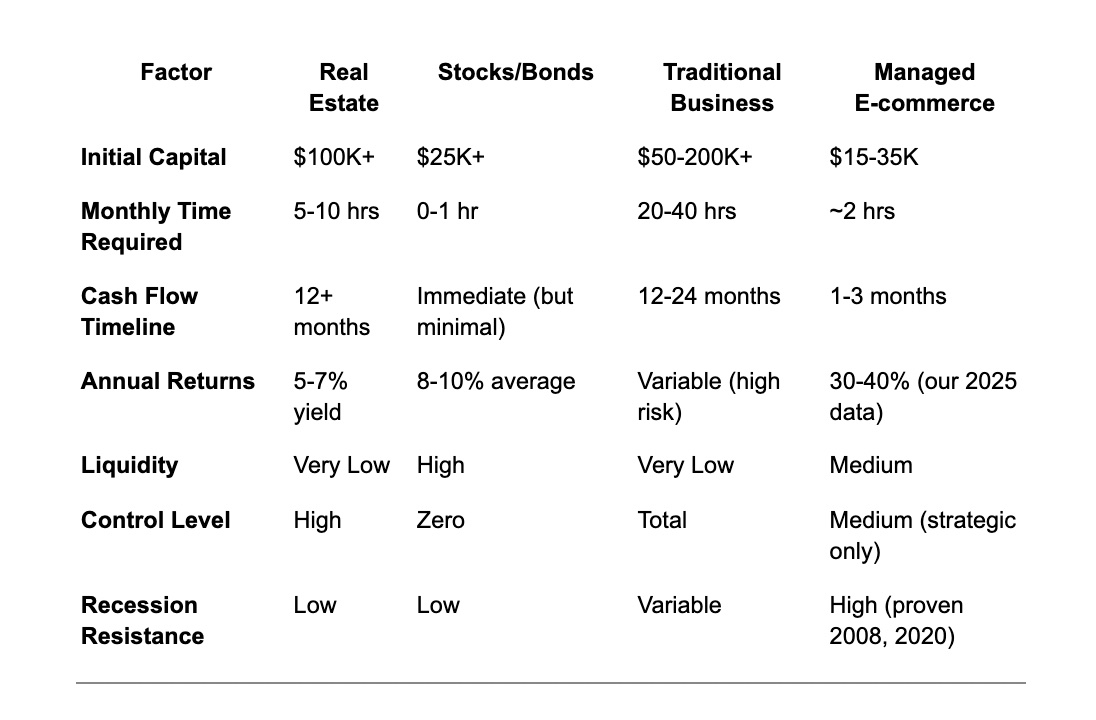
Traditional investment strategies, real estate, stocks, and bonds, serve important roles in wealth building but fall short of providing the monthly cash flow diversification that high earners need to protect against career disruption.
Real Estate Investing:
Great for long-term wealth building, but the barriers in 2026 are significant:
- Down payments: $100,000+ per property minimum
- Current interest rates: 6-7% crushing cash flow potential
- Average rental yield: 5-7% after property taxes, insurance, maintenance
- Time commitment: 5-10 hours monthly managing properties
- Liquidity: Very low when you need capital quickly
After managing properties for years, most professionals discover rental income barely covers the mortgage after expenses, not the cash flow diversification they need.
Stock Market Investing:
Solid foundation for retirement, but faces critical limitations:
- S&P 500 historical average: 8-10% (when markets cooperate)
- Dividend yields: 2-4% annually
- Volatility: Regular 20-30% drawdowns
- Control: Zero, you're completely dependent on market forces
- Psychological barrier: Most people can't touch principal without anxiety
- Paper gains: Don't pay this month's mortgage
Starting a Traditional Business:
Powerful path to independence, but incompatible with high-earner schedules:
- Time requirement: 20-40 hours weekly initially
- Learning curve: 6-18 months to profitability
- Capital risk: $50,000-200,000+ depending on industry
- Opportunity cost: Income lost from reduced career focus
- Success rate: 80% of new businesses fail within 5 years
These aren't bad strategies, they're incomplete.
They work for wealth accumulation but don't solve the immediate problem: generating monthly cash flow that protects you from career disruption without requiring a second full-time job.
What Makes E-commerce a Crisis-Resistant Income Stream?
e-commerce has proven recession-resistant across multiple economic crises because it serves a fundamental need, product access, that persists regardless of economic conditions, unlike discretionary spending that fuels most traditional businesses.
The historical proof:
2008 Financial Crisis:
- Stock market: -37%
- Real estate: Collapsed
- Unemployment: Skyrocketed to 10%
- E-commerce: +3.5% growth
COVID-19 Pandemic (2020):
- Dow Jones: -37% in 5 weeks
- Physical retail: 60% permanently closed
- Unemployment: Historic levels
- E-commerce: +44% growth
Why this pattern exists:
When economic uncertainty hits, consumer behavior shifts but doesn't stop:
- People still need household essentials (cleaning supplies, pet food, personal care)
- Physical store access becomes limited or undesirable
- Price comparison increases (favoring online marketplaces)
- Convenience becomes premium (delivery over in-store shopping)
- Product categories expand online during every crisis
E-commerce fundamentals that create stability:
- Serves essential product demand (not discretionary luxury spending)
- Benefits from physical retail disruption
- Operates 24/7 without geographic limitations
- Scales without proportional cost increases
- Diversifies across hundreds of products and categories
From our experience managing 300+ stores through various market conditions: e-commerce cash flow remained stable even when our partners' stock portfolios dropped 30%+ and rental properties faced tenant payment issues.
The key difference? When people can't afford to go out, they shop online. When they lose jobs, they buy essentials online. When uncertainty rises, e-commerce becomes the default.
How Does a Managed E-commerce Store Work for Busy Professionals?
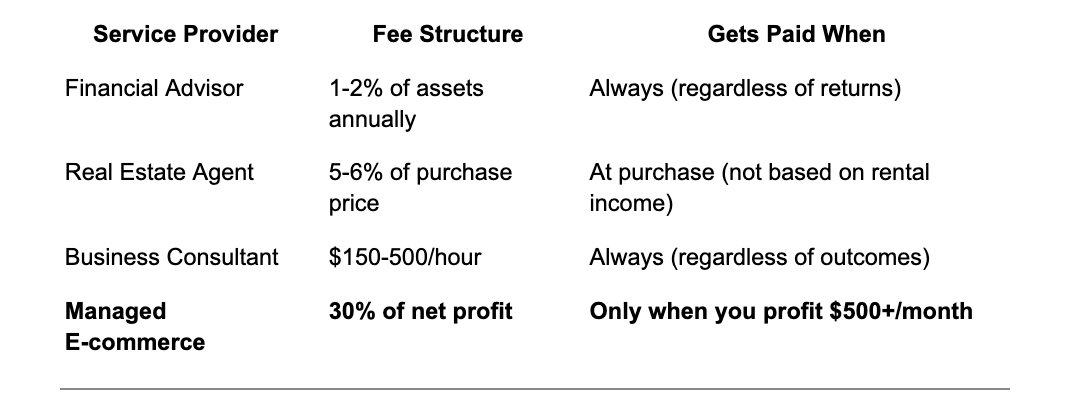
A managed e-commerce store operates on a turnkey model where professional operators handle all daily operations, marketing, and fulfillment while you retain ownership and receive monthly profit distributions, requiring approximately 30 minutes weekly of your time for strategic oversight.
Unlike traditional businesses requiring your time and expertise, or investments requiring market timing, managed e-commerce creates a middle path: asset ownership without operational burden.
Here's exactly what we handle:
Product Research and Selection
Our team analyzes performance data from 300+ stores to identify products with proven demand:
- Track sales velocity across platforms (eBay)
- Monitor profit margins and competition levels
- Identify trending categories before saturation
- Test product viability using existing store data
- Source from established supplier relationships
Your involvement: None. We present final recommendations for approval.
Store Setup and Compliance
Complete platform registration and optimization within 31 days:
- Business entity registration guidance
- Platform account setup (eBay and/or)
- Payment processing integration
- Listing template creation
- Initial inventory strategy
- Compliance with platform policies
Your involvement: 2-3 hours during onboarding (verification, account access)
Daily Operations Management
Everything required to process orders and maintain customer satisfaction:
- Order fulfillment coordination
- Supplier communication and purchasing
- Shipping logistics
- Inventory tracking (using sell-first, buy-later model)
- Returns and refund processing
- Customer inquiry responses
- Platform policy compliance
Your involvement: Zero. We handle all operational execution.
Marketing and Growth
Strategic promotion using proven methods:
- Product listing optimization for platform algorithms
- Paid advertising campaigns (we cover ad spend)
- Seasonal promotion planning
- Pricing strategy adjustments
- Category expansion recommendations
- Performance analytics and reporting
Your involvement: 30 minutes weekly reviewing performance reports, approving scaling decisions.
The sell-first, buy-later model eliminates inventory risk:
Traditional e-commerce requires buying inventory upfront, tying up $10,000-50,000 in products that might not sell.
Our model works differently:
- List products on your eBay store
- Customer places order and pays
- We purchase product from supplier using customer payment
- Supplier ships directly to customer
- You receive profit after product cost and fees
Result: Zero inventory risk. Capital recycles every 3-7 days. No warehouse costs. No unsold product risk.
Why 2026 Makes Income Diversification More Urgent Than Ever
Three converging forces make income diversification critical for high earners in 2026:
AI Disruption Accelerating
Goldman Sachs research predicts AI will eliminate or significantly alter 300 million jobs globally by 2030. This isn't distant future, it's happening now:
- Customer service roles: Automated by AI chatbots
- Data analysis positions: Replaced by AI systems
- Content creation: Increasingly AI-generated
- Financial analysis: Automated by algorithms
- Legal research: AI-performed at fraction of cost
- Medical diagnostics: AI-assisted at scale
Impact on high earners: Many $100,000-200,000 positions involve tasks AI performs well, analysis, research, content creation, data processing.
Corporate Restructuring Normalized
Tech layoffs in 2023-2024 established new precedent:
- Google, Meta, Amazon: Combined 50,000+ layoffs
- Age discrimination (disguised as "restructuring")
- Performance improvement plans replacing job security
- Elimination of entire departments
- Merger consolidations
Pattern shift: Twenty-year careers at one company no longer exist. Average tenure at FAANG companies: 3-5 years.
Traditional Portfolio Vulnerability
The problem with 60/30/10 allocation:
All three components require the same foundation:
- Stable employment funding investments
- Growing economy supporting stock prices
- Low inflation protecting bond yields
- Consumer spending driving corporate profits
When AI eliminates your job: None of these assets generate monthly cash flow to replace lost income. You're forced to sell assets (possibly in down market) to fund lifestyle.
Real Diversification Requires Income Diversification
False diversification: Stocks + Bonds + Real Estate = Multiple bets on same economic outcome
True diversification: Career Income + Investment Growth + Monthly Cash Flow = Multiple income sources surviving different scenarios
The test: "If I lost my job tomorrow, what income arrives next month?"
For most high earners, the honest answer is: Almost nothing.
What Happens After Your Store Matures?
After 12-18 months of maturation, successful e-commerce stores typically reach a stable equilibrium where monthly cash flow becomes predictable, creating three strategic options: maintain current scale, reinvest profits for growth, or add additional stores for portfolio diversification.
Typical month 12-18 position:
For a $25,000 initial investment:
- Monthly revenue: $8,000-15,000
- Monthly net profit: $2,000-4,000
- Your 70% share: $1,400-2,800/month
- Annual cash flow: $16,800-33,600
Three paths forward:
Option 1: Maintain Current Scale
Strategy: Take all monthly distributions as income without reinvestment.
Best for:
- Professionals prioritizing current cash flow
- Those approaching retirement (5 years out)
- Individuals wanting stable passive income
- Risk-averse operators preferring stability
Result: Consistent monthly cash flow with minimal additional work. Store maintains current performance level.
Option 2: Reinvest for Growth
Strategy: Reinvest 50-100% of monthly profits into inventory expansion, new product categories, or marketing.
Best for:
- Professionals with 10+ years until retirement
- Those comfortable with growth focus
- Individuals seeking to maximize returns
- High earners who don't need current cash flow
Result: Accelerated growth. Store potentially doubles output within 12-24 months. Higher ultimate cash flow but delayed gratification.
Example trajectory:
- Year 1: $25,000 investment → $2,000/month profit
- Year 2: Reinvest profits → $4,000/month profit
- Year 3: Reinvest profits → $6,000-8,000/month profit
Option 3: Add Additional Stores
Strategy: Use cash flow from Store #1 to fund Store #2, creating portfolio of income-generating assets.
Best for:
- Professionals seeking maximum diversification
- Those with additional liquid capital when they are ready to expand
- Individuals wanting platform diversification (eBay +)
- High earners building exit strategy from corporate career
Result: Multiple income streams. If Store #1 = $2,500/month, Store #2 = $2,500/month, total = $5,000/month after maturation.
Portfolio approach:
- Store #1 (eBay): Stable, predictable, mature platform
- Store #2 (eBay): Different category mix for diversification
- Store #3 (optional): Further diversification
Combined effect: $5,000-7,000/month in cash flow = $60,000-84,000 annually from e-commerce alone.
Frequently Asked Questions
How much time does a managed e-commerce store actually require?
Setup takes 2-3 hours for onboarding and verification. Ongoing involvement is 30 minutes weekly reviewing performance reports and approving strategic decisions.
What happens if the store doesn't generate profit within 16 months?
We pause our profit share entirely and continue managing your store for free, giving you 100% of net profits until you've recovered your initial investment. Then we return to the profit split defined in your agreement.
How is this different from starting my own e-commerce business?
Starting your own requires 20-40 hours weekly and 6-12 months learning curve. Managed e-commerce provides asset ownership without operational burden, similar to owning rental property with a property manager.
What platforms do you use and why?
We focus on eBay (133 million active buyers, 30-year stability). eBay provides built-in search demand, unlike Shopify where you fund your own traffic. We avoid Amazon due to extreme competition and margin compression.
Can I see the actual performance data supporting your return claims?
Yes. Our FTC Earnings Claims Disclosure document is available during your strategy call, showing detailed performance data including average, highest, lowest, and median outcomes from our partner stores.
What's the biggest risk with managed e-commerce stores?
Platform dependency, subject to eBay policy changes. We mitigate through strict compliance, multi-SKU diversification, and established platform relationships. Secondary risks include supplier reliability and category saturation, both managed proactively.
How much capital do I actually need to get started?
Many operating partnerships require $20,000+ in upfront capital depending on platform, SKU depth, and operator (industry-wide benchmarks—not a published price list for Ecom Accelerator). Your exact requirements are defined in your service agreement after a strategy call.
That capital typically covers store setup, initial working reserves, and early inventory purchases against confirmed sales. Timelines to traction vary by category and account maturity; many stores need roughly 60–90 days before growth dynamics compound.
Beyond the upfront commitment, you need ongoing working capital for product purchases. In a sell-first, buy-later model, capital often recycles every few days as the platform pays out, but reserves still matter for velocity and exceptions.
Can I start with one store and add more later?
Yes, and this is the most common approach. Most partners start with one store (typically eBay for stability or for growth potential), allow 6-12 months for maturation, then add a second store using either: cash flow from first store (no additional capital required), additional capital per your agreement for a second platform, or combination of both. The advantage of sequencing: learn the model with one store before scaling, avoid over-extending capital early, and make informed platform choices based on first store performance.
Your Next Step: Schedule a Strategy Call
You can enter 2026 trapped in the high earner paradox, completely dependent on a single paycheck, hoping your job survives industry disruption, watching others build income diversification while you stay stuck.
Or you can build monthly cash flow that protects your family whether your career continues or not.
What happens on a strategy call:
We'll review:
- Complete FTC Earnings Claims Disclosure (legally required, fully transparent)
- Detailed performance data from our 300+ partner stores
- Platform selection recommendation based on your goals (eBay vs)
- Timeline expectations and maturation process
- Capital requirements and profit split structure
- Your specific questions about the model
We'll discuss:
- Your current income diversification strategy
- Career stability and industry outlook
- Timeline to retirement or financial independence
- Risk tolerance and investment experience
- Whether managed e-commerce aligns with your situation
You'll leave with:
- Clear understanding of how the model works
- Realistic expectations for returns and timeline
- Capital requirement breakdown
- Decision framework for whether to proceed
- No pressure, we only work with partners who clearly fit the model
The professionals who build income diversification successfully aren't the ones who wait for perfect timing.
They're the ones who recognize opportunity, evaluate it thoroughly, and act while others are still "thinking about it."
Schedule your strategy call now.
Frequently Asked Questions
1. Why are high earners more financially vulnerable than lower earners?
+High earners face greater vulnerability because their lifestyle expenses scale proportionally with income, creating complete dependence on a single paycheck. Replacing a $250,000 position takes 6-12 months on average, while monthly obligations of $15,000-25,000 don't pause during job searches.
2. Can traditional investments solve the high earner income diversification problem?
+Traditional investments like real estate and stocks serve wealth-building purposes but fall short of providing monthly cash flow diversification. Real estate requires $100,000+ down payments and 5-10 hours monthly management. Stocks offer 2-4% dividend yields and don't provide reliable monthly income.
3. What makes e-commerce different from other income diversification strategies?
+E-commerce provides monthly cash distributions without requiring a second full-time job, large capital deployment, or significant time investment. Managed e-commerce stores can generate consistent income while you maintain your primary career.
Disclaimer: Performance figures referenced are based on our earnings claims disclosure and reflect historical results from January 2025 through December 2025. These figures are not a promise or guarantee of future performance. Results vary widely based on factors including product selection, platform policies, account health, customer demand, pricing, and operational execution. This is a business opportunity, not an investment, and there is risk of loss. Our FTC-backed earnings claims disclosure shows 32% ROI on inventory sold from January 2025 through December 2025.